
AI-Driven Inventory Optimization for Reduced Inventory Costs & Asset Reliability
PiLog Inventory Optimization provides a data-driven framework to balance operational resilience with financial efficiency. By combining advanced criticality scoring (VED/HML) with automated MRP planning, we transform bloated warehouses into streamlined, high-availability supply chains.
Advanced ABC/FSN/XYZ Analysis
Real-time Obsolete Stock Detection
Automated Safety Stock & EOQ Calculation
ISO 8000 Data Harmonization Native
25 - 30%
Avg. Inventory Reduction
$4.5M
Typical Annual Savings
98%
Service Level Target
3 – 5x
Return on Investment
8 Months
Payback Period

HIGH IMPACT
Excess stock ties up working capital and increases insurance, handling, and obsolescence risks.

HIGH IMPACT
Inaccurate criticality rankings mean the wrong parts are in stock, leading to extended production downtime during failures.

HIGH IMPACT
Lack of data-driven Re-Order Points (ROP) leads to emergency spot-buys and high freight premiums.
The Business Problem
Fragmented Designations Are Costing You Millions
Industrial enterprises lose millions to inconsistent equipment identification. Without a unified Reference Designation System (RDS), data handover between engineering, procurement, and maintenance is broken, leading to operational delays and maintenance errors.

CLASSIFY
Multi-Dimensional Analysis. We apply ABC (Value), FSN (Flow), XYZ (Stock Accumulation), and VED (Criticality) to categorize every material.

QUANTIFY
Criticality Scoring. Our MCA/MCR tool generates a composite score based on production impact, lead time, and safety risk.

OPTIMIZE
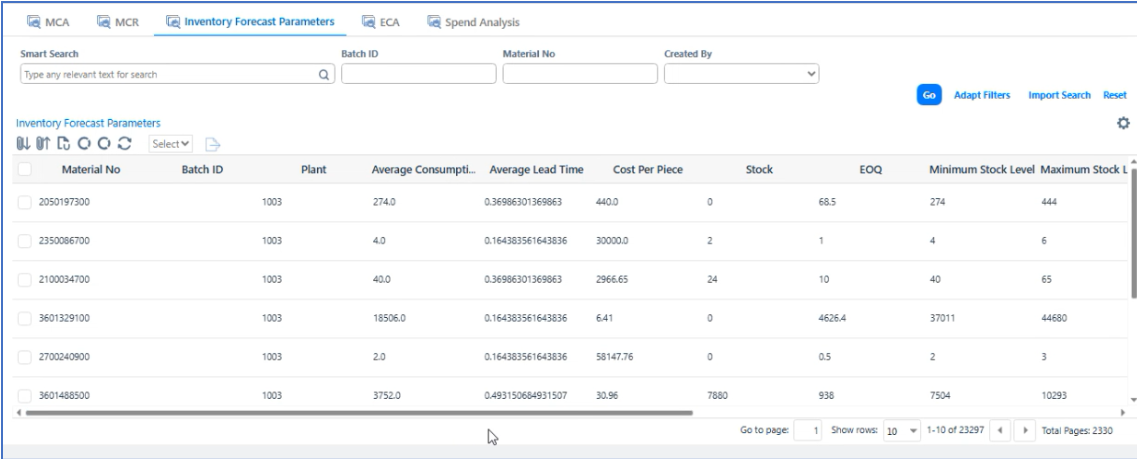
Planning Parameters. The system automatically calculates Economic Order Quantity (EOQ), Safety Stock (SS), and Min/Max levels to align with actual Demand
The Pilog Solution
Classify. Quantify. Optimize.
The PiLog framework utilizes six-dimensional analysis to ensure every SKU has a scientifically determined stocking strategy
1
Continuous Governance: Monitor consumption rates and lead times to dynamically adjust levels & prevent obsolescence.
2
Parameter Calculation: Apply statistical formulas to define ROP and Safety Stock based on lead-time variability.
3
Inventory Categorization: Segment stock using HML (Unit Cost) and SDE (Sourcing Ease) to determine procurement strategies.
4
Criticality Assessment: Evaluate materials based on Production Impact, Sourcing Difficulty, and Safety Risks.
5
Data Harmonization: Cleanse and standardize raw data to ensure accurate “Inputs” for the analysis engine
The Optimization Methodology
A Balanced Ecosystem in 5 Steps
1
2
3
4
5
Quantified Value
OPERATIONAL
Stockout Incidents
-50%
Asset Availability
+15%
Procurement Cycles
-40%
FINANCIAL
Working Capital
+25%
Carrying Costs
-30%
Annual Savings
$4.5M
ENGINEERING
Forecasting Accuracy
95%
Lead Time Variability
-20%
Obsolete Stock
-60%
Optimization Tools & Technology
MCA & MCR Tool
Proprietary engine for ranking material criticality and production impact scores.
| Material | Criticality Score | Impact | MCR Score | ||
|---|---|---|---|---|---|
| Supply | Profit | Production | |||
| 1500111257 | >=18 | 3 (High) | |||
| 1500092819 | 13-18 | 2 (Medium) | |||
| 1500092923 | <=13 | 1 (Low) | |||
Optimization Workbench
Dashboard for simulating “What-If” scenarios on stock levels vs service goals.
Scenario Controls
Service Level Goal
95%
80%
99%
Budget Constraint
2,500,000
$1M
$5M
- Recommended Scenario
Scenario 2
Best balance of service and cost
Automated MRP Engine
Direct integration with ERP to trigger procurement based on calculated ROP/EOQ.

ERP System
Demand & Inventory Data

MRP Engine
Calculate ROP/EOQ & Requirements

Procurement Trigger
Auto-generate PR/PO in ERP

Purchase Order
Sent Supplier
| Material | ROP | EOQ | Stockout | Action | Status |
|---|---|---|---|---|---|
| 1500111257 | 120 | 600 | 12 days | Create PO | Triggered |
| 1500092819 | 80 | 400 | 08 days | Create PO | Triggered |
| 1500092923 | 60 | 300 | 15 days | Create PR | Pending |
Frequently Asked Questions
Asset-intensive industries face the challenge of balancing high service levels with high carrying costs. Maintaining optimal stock levels for critical MRO (Maintenance, Repair, and Operations) spares is difficult because understocking can lead to unplanned downtime, while overstocking ties up significant working capital in inventory. PiLog addresses this challenge by optimizing parameters such as Safety Stock (SS), Reorder Points (ROP), and Minimum/Maximum inventory levels.
PiLog uses a Multi-Attribute Criticality Analysis to prioritize inventory. This assessment evaluates factors such as Spend Year-over-Year (ABC Analysis), Consumption Patterns (FMSN Analysis), Inventory Hoarding Trends (XYZ Analysis), and the operational impact of item failure through VED (Vital, Essential, Desirable) Analysis. This ensures that high-value and business-critical items receive the highest priority.
By aligning inventory strategies with maintenance plans, PiLog ensures that the right spare parts are available exactly when required for scheduled maintenance activities. It integrates with Enterprise Asset Management (EAM) systems to manage Task Lists and Maintenance Plans, reducing the risk of deferred maintenance caused by unavailable spare parts.
PiLog provides Real-Time Inventory Hoarding Insights to identify spare parts that are unnecessarily stocked at individual units or locations. It supports optimization strategies such as Hub-and-Spoke Distribution and Centralized Inventory Planning, enabling organizations to share inventory across multiple sites while maintaining availability and reducing excess stock.
PiLog leverages AI-powered analytics to improve inventory planning by analyzing historical consumption, demand patterns, asset criticality, and maintenance schedules. AI helps identify excess inventory, predict future spare part requirements, recommend optimal stocking levels, and improve replenishment decisions, reducing carrying costs while maintaining high service levels.
Yes. PiLog’s inventory optimization approach extends beyond direct materials to include indirect materials and services. It helps classify commodities, manage service agreements, and optimize inventory levels for both goods and services, reducing the Total Cost of Ownership (TCO) across the supply chain.
The iContent Foundry provides standardized, high-quality master data that serves as the foundation for accurate inventory optimization. By ensuring that spare part identifiers, descriptions, and specifications are consistent and ISO 8000-compliant, PiLog enables reliable categorization, accurate criticality analysis, and more effective inventory planning.
Organizations implementing PiLog’s Inventory Optimization solution typically achieve optimized inventory levels, reduced MRO inventory costs, improved spare parts availability, lower inventory carrying costs, and better asset uptime. The solution enhances procurement efficiency, minimizes stockouts and excess inventory, and supports data-driven decision-making across the asset lifecycle.
Ready to Unlock Your Working Capital?
Join the organizations using PiLog Inventory Optimization to reduce excess stock by 30% while improving service levels